
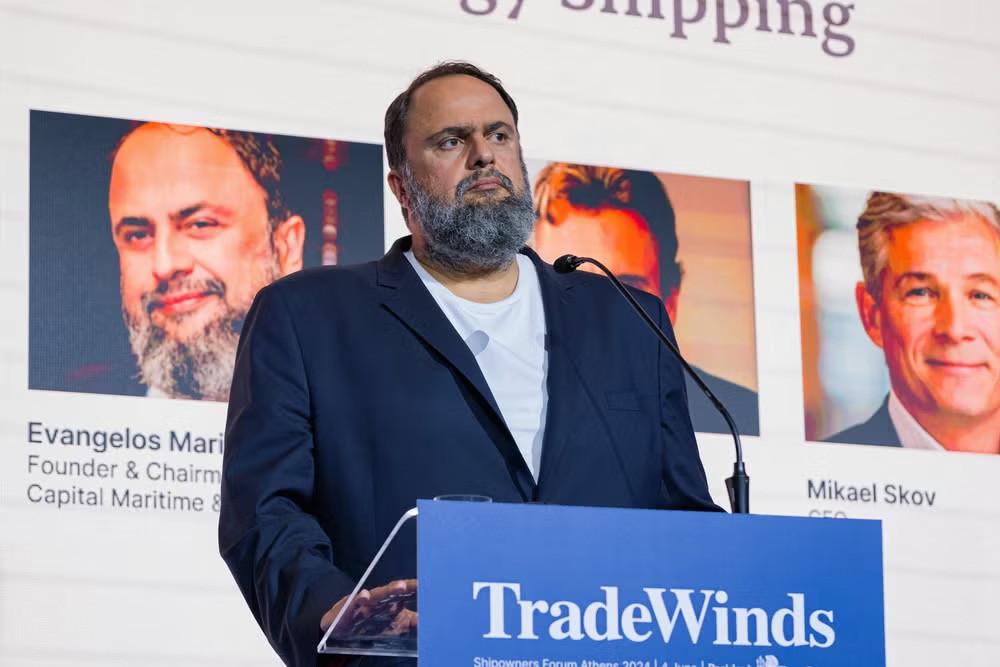
How Marinakis’ $500m IPO put Oslo back on the shipping map
This week’s Streetwise sees veteran Capital Maritime executive Jerry Kalogiratos reflect on the changing IPO landscape
When Evangelos Marinakis floated the largest IPO in more than 20 years with a $500m deal last month, it was a power statement in more ways than one. First, it was one for the Greek shipowner himself.
Then one for a tanker market that has been on a rampage, especially in VLCCs, whatever one thinks of the 800-pound gorilla in the room that is menacing energy supplies from the Middle East.
But the third big winner was Oslo as a place to raise equity.
The Norwegian capital was once regarded as a place for smaller IPOs — a short-term growth incubator for owners who would likely migrate the listing to New York.
And for shipowners wanting a bigger initial IPO, New York was, for a long time, almost always the place to go.
Indeed, it was once the path for Marinakis himself.
Streetwise recalls the Greek billionaire’s first stab at floating a public crude-tanker company. This was called Crude Carriers, and it came in 2010, following Marinakis’ 2007 listing of Capital Product Partners.
Of course, it came in New York. And while the $256m it raised is hardly pocket change, for perspective, this is barely half of what Capital just managed to score in Norway.
We suspected we were not the only ones struck by how markets have changed in those 16 years.
So we turned to longtime Capital Maritime executive Jerry Kalogiratos — who was smack in the middle of both IPOs — for his thoughts on the transformation.
“Indeed, the landscape has evolved significantly since the days of Crude Carriers in 2010,”
Kalogiratos told us this week. He highlighted what he called “pivotal changes” in three areas.
“First, whereas the US was previously the primary destination for international shipping companies, Oslo has since developed considerable financial scale, gained prominence within maritime circles and built a solid reputation.
“Second, Oslo now stands at the forefront of maritime and shipping research, recognised globally,” especially as several US banks have either exited or dramatically scaled back coverage of shipping stocks, he noted.
“This advancement provides Oslo with unparalleled access to key investment pools, enabling companies like ours to connect with a broader range of investors—not only locally, as was the case in 2010, but across Europe, the UK, the US and worldwide.”
The third point cited by the longtime Marinakis lieutenant turns to the US, where there has been exactly one successful regular-way shipping IPO — Zim in January 2021 — since the summer of 2015.
It highlights the continued importance of the US market, but also some of the disadvantages that help make Oslo the leading IPO choice.
He said: “Access to capital pools in the US remains a central objective for us. However, a sole listing in the US entails considerable time, effort and expense.
“By leveraging Euronext Growth in Oslo, we were able to act swiftly and efficiently. “The process, while rigorous, offered us a timely route to investors, allowing us to demonstrate our capabilities and performance over time.”
That opens the door to expanding the listing to the US, perhaps by the end of 2026, according to some sources.
Kalogiratos called this “a fundamental ambition for Capital Tankers”.
Capital is not alone as a crude player raising funds in Oslo but ultimately targeting a US listing.
Tor Olav Troim’s start-up VLCC venture Burton has raised $160m so far in Norway but is thought to be targeting a US registration this year for further funding.
Greek owner Okeanis Eco Tankers launched its fleet of modern VLCCs and suezmaxes in Oslo, then expanded the listing to New York in December 2024. Last year, it was the top performer among US-listed shipping stocks.
Is there hope, however, that the US will recover its place as a market for direct shipping IPOs?
A finance panel talked about that a little bit at Capital Link’s 20th international shipping forum in New York earlier this week.
SFL Management chief executive Ole Hjertaker reminded the audience that Norwegian investors had been highly active with shipping bets between 2003 and 2005 before a recordsetting IPO wave ignited in New York.
Hjertaker said: “If you talk about 20 years ago, the first few years from 2002 through 2005 were dominated by Norwegian investors. They look at [net asset value]. It’s all about NAV, NAV, NAV. That’s what they invest around.
“And then, when they felt that had gone too far, that’s when the US investors came in. And it just went right up from there.
“So the question is, when will the new generation of investors come into this market, who don’t care about NAV and don’t care about some broker deal [and invest] because of the dividends and the cash flows we will see coming.”
US-based investment banker Wiley Griffiths with Morgan Stanley answered with something that sounded less than full-throated optimism.
Griffiths was leading deals for the likes of Teekay, Scorpio Tankers, Nordic American Tankers, Costamare and Ardmore Shipping during those boom days of the late “oughts”.
But the ensuing shipping IPO drought has essentially left him an “other transportation” banker in recent years while playing the waiting game.
“Maybe I’m jaded because I went through this long IPO virtuous cycle years ago, [but] it’s selective,” Griffiths said of shipping interest from US investors.
On the one hand, New York-listed companies are better capitalised and “investable” than ever and present excellent “comps” for any newcomer trying to float an IPO, Griffiths said.
“But I think investors are still wary of micro-cap stocks, for lack of a better description,” Griffiths said, adding, “when you want to exit that investment, it’s going to be really tricky when the cap-and-flow is small”.